

“I’m sorry, but what’s your point?”
Five innocent words that once plunged me into a day-long meeting.
The manager started rambling, roped in five more people, and we accomplished… absolutely nothing.
Lesson learned: Being to the point isn’t just nice, it’s crucial.
The Power of Conciseness
Sure, sometimes you need to set the stage. But once you do, for the love of productivity, tell me what you want, need, or are asking. It’s that simple.
Starting my own company hammered this home. But when I’m in doubt, I remember the world’s most concise scientific article.
And no, it wasn’t published on the back of a cereal box.
The Two-Sentence Breakthrough
Picture this: Two sentences. That’s it. Published in the prestigious Bulletin of the American Mathematical Society.
What did it prove? That even geniuses can be wrong.
Here’s the backstory:
In 1769, math bigwig Euler proposed that to find a number’s nth power, you’d need to sum at least n other numbers, each raised to the nth power.
For example, 6^3 = 216 = 3^3 + 4^3 + 5^3.
Three cubed numbers for a cube.
Neat, right?
Wrong.
The Mic Drop Moment
In 1966, Lander and Parkin dropped this mic:
“27^5 + 84^5 + 110^5 + 133^5 = 144^5”, meaning, you can also achieve a result with (n-1) numbers.
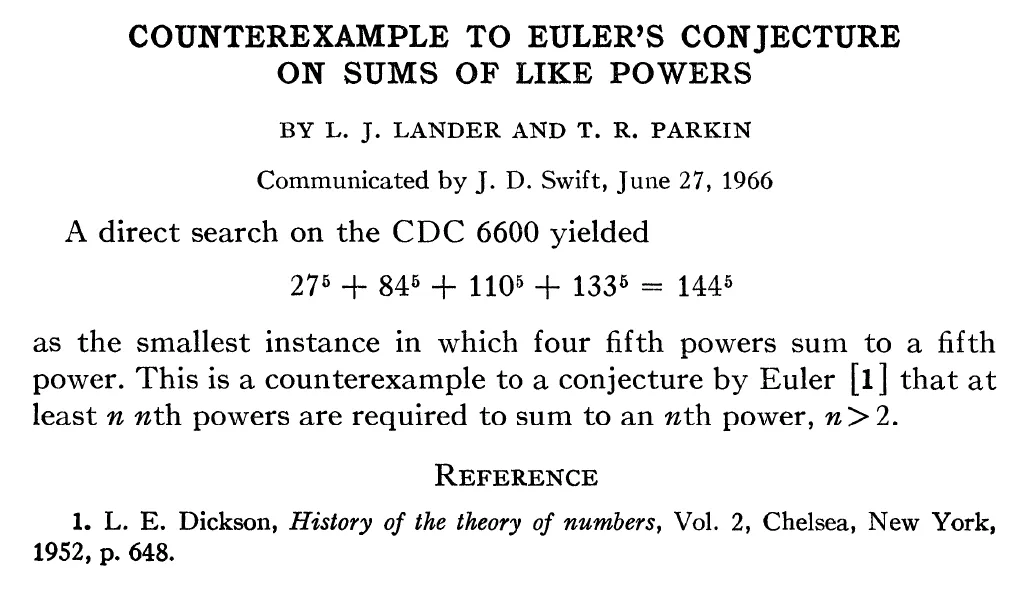
Translation: “Hey Euler, we just found a fifth power using only four fifth powers. Your theory’s toast. Q.E.D.“
That’s it. That’s the entire article. No fluff, no beating around the bush. Just pure, unadulterated point-making.
The Lesson
The lesson is if you have a point, make it.
Clearly. Concisely. Concretely.
Oh, and that colleague who sparked this rant? His point remains a mystery to this day. But hey, at least we spent a week solving a five-minute problem, right?
Conclusion
Next time someone asks you to get to the point, channel your inner Lander and Parkin. Your colleagues (and their sanity) will thank you.
What is Q.E.D.?
Q.E.D. stands for “Quod Erat Demonstrandum,” a Latin phrase meaning “what was to be shown.”
Mathematicians and philosophers have used it for centuries to signify the end of a proof.
It’s like saying, “There you have it, folks. Point made.”
In everyday language, we use Q.E.D. to emphasize that we’ve conclusively proven our point.
Just like Lander and Parkin did with their two-sentence mic drop.
Disclaimer
Photo by Ferhat Deniz Fors on Unsplash.
 OGC Labs
Leave a Reply