

Welcome back to our exploration of Generative AI.
In Part 1, we introduced the concept of generative AI and its inner workings.
Now, let’s delve deeper into its capabilities, limitations, and a fascinating real-world application.
Recap of Part 1
We learned that generative AI refers to algorithms capable of creating new content across various mediums.
These models, built on transformer architecture, are trained on massive datasets, learning patterns and relationships to generate new content.
Capabilities and Limitations
While generative AI shows impressive capabilities, it’s important to understand and be aware of its limitations.
Wearing my actuary cap, let’s analyze this technology from a risk management perspective.
#1 Factual Accuracy
These models may generate false statements.
A Stanford study found that large language models (LLMs) can produce inaccurate information in about 25% of cases when elaborating on a given topic.
#2 Bias
The models can perpetuate and amplify societal biases present in their training data.
In insurance, such biases are mostly prevented through regulations and professional associations.
#3 Resource Intensity
Running these models requires significant computational resources.
For example, Microsoft’s 2024 Environmental Sustainability Report shows a 29.1% increase in overall emissions in FY23 as the company has been integrating generative AI as part of its core value proposition.
The World Economic Forum estimates that training a model like GPT-3 uses the annual power consumption of 130 US homes.
Real-World Application: Can AI Craft Safer Antibiotics?
Eight years ago, I experienced a Fixed Drug Eruption after using a well-known class of antibiotics, which recurred recently.
After multiple hospital visits, my doctor advised me to avoid (A) two classes (let’s call them A1 and A2) while confirming I can safely take (T) T1 and T2.
This experience made me wonder: What if we could develop medications that are both highly effective and less likely to cause such specific adverse reactions?
The AI Drug Designer
Imagine a generative AI system designed to accelerate and enhance the drug discovery process, focusing on creating safer, more targeted antibiotics:
Step #1 Data Collection
From the Goodman & Gilman’s Blue Bible of Pharmacology to Harrison’s Principles of Internal Medicine, let’s start feeding vast amounts of data, a.k.a. oceans of text, including:
- Molecular structures of existing antibiotics (A1, A2, T1, T2)
- Protein structures of various bacteria and their interactions with antibiotics
- Results from millions of past clinical trials, including allergic reaction data
- Scientific papers on antibiotic mechanisms and allergic responses
- Genetic data related to antibiotic allergies and effectiveness
Step #2 Model Training
In order to identify patterns, we will need to utilize two principal branches of mathematics: statistics and probability.
Let’s use a type of machine learning algorithm, generative pre-trained transformer or GPT, to process this data to learn complex relationships, such as:
- Structural differences between allergy-causing antibiotics (like A1) and safer ones (like T1)
- How chemical structure changes affect allergic reaction likelihood
- Genetic markers predisposing individuals to specific antibiotic allergies
Step #3 Pattern Recognition
Neurons in our brain communicate with each other through bioelectrochemical reactions.
A “lighter” reaction connects them loosely, like the movie you saw years ago, vs. a “harder” reaction connects them densely, like the movie you watched with your loved one years ago.
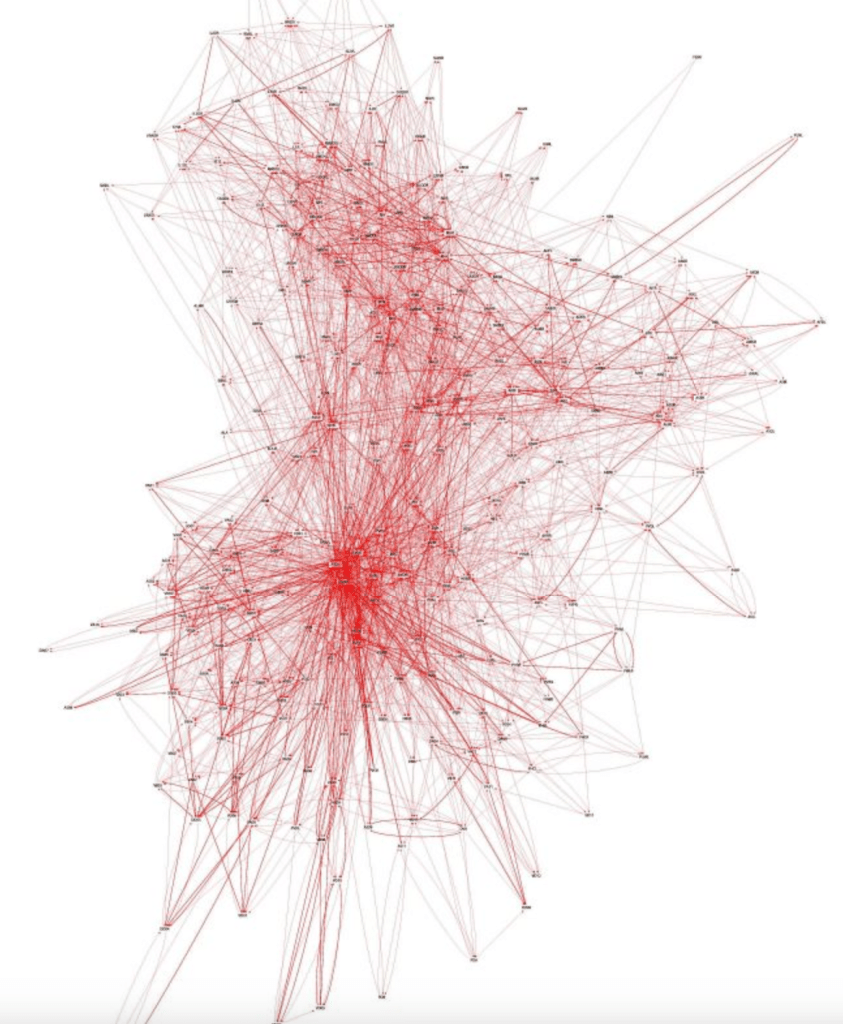
We mimic this with GPTs, where instead of reactions we assign a number between 0 and 1. This is how the AI recognizes patterns, such as:
- Common molecular features in antibiotics triggering allergic responses
- Relationship between antibiotic effectiveness and structure
- Correlations between genetic markers and specific antibiotic allergies
Step #4 Output Generation
When you task it with developing a new antibiotic for people with allergies similar to mine, the AI will first decompose all the words in the task, and then look for high-probability words (a number closer to 1) in the oceans of text.
Then the AI could:
- Design a novel antibiotic structure mimicking A1’s effectiveness but less likely to trigger allergic responses
- Suggest modifications to A2 to reduce allergic potential while maintaining effectiveness
- Propose a new antibiotic class combining T1’s safety profile with A1’s broad-spectrum effectiveness
Step #5 Refinement
As AI-generated designs are tested, results feed back into the system, continuously improving its ability to create safe, effective antibiotics.
This approach could lead to personalized antibiotic treatments considering individual allergy profiles, potentially reducing hospital visits and severe allergic reactions for people like me.
Looking Ahead
In Part 3 of our series, we’ll explore the impact and adoption of generative AI across various industries.
We’ll examine how different sectors are leveraging this technology and look at some compelling statistics on its economic impact.
Stay tuned as we continue our journey into the world of generative AI.
This article is part of a 5-part series on Generative AI. For a complete list of references used throughout this series, please visit https://ogclabs.com/2024/07/29/generative-ai-series-references-and-navigation/

 OGC Labs
Leave a Reply to Generative AI: Preparing Your Business for the AI Revolution (Part 5 of 5) – OGC Labs Cancel reply